
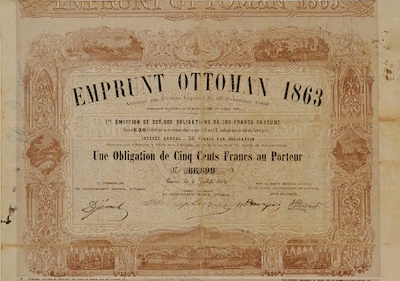
How Ottoman bonds predicted global conflict?
Markets Knew War Was Coming: How Ottoman Bonds Predicted Global Conflict – And Why Oil Prices May Be Today’s Red Flag
By Financial Correspondent
The Shocking Truth: Markets Saw WWI Coming – Long Before the First Shots Were Fired
Forget what you were taught in history class. The First World War wasn’t a complete surprise — not if you were watching the right markets.

New historical research reveals that investors holding Ottoman Empire bonds began reacting years before war officially broke out in 1914. Bond prices in cities like Istanbul, Berlin, and Paris showed sudden and sustained volatility – classic signs that investors were anticipating massive geopolitical fallout.
By contrast, London’s market stayed remarkably calm, suggesting British investors were either unaware or unconvinced that Europe was heading for catastrophe.
Canary in the Coal Mine: Why Bond and Commodity Markets React First
Markets don’t just respond to events — they often predict them. Think of them as the canary in the coal mine: when risk rises, the first sign is often a sharp jolt in prices or a break in long-term trends.
Bond markets, in particular, are highly sensitive to political uncertainty. Sudden “structural breaks” — big, sustained deviations in price or volatility — signal deep investor unease.
In the early 1900s, Ottoman bonds experienced just that. These shifts occurred during key flashpoints, like Austria-Hungary’s annexation of Bosnia-Herzegovina in 1908, long before the Sarajevo assassination triggered full-scale war.
Then and Now: From Ottoman Bonds to Russian Gas
Fast-forward to today, and we see a disturbingly similar pattern. In the lead-up to Russia’s 2022 invasion of Ukraine, commodity prices — especially oil and gas — began flashing red.
Initially, markets absorbed the risk. But as tensions mounted, energy prices started transmitting volatility across the global system. By the time the tanks rolled in, financial markets had already “priced in” the danger.
What This Means for Investors – And Everyone Else
Not all markets react the same. Proximity to conflict, economic ties, and historical exposure all shape how investors respond. That’s why Istanbul and Berlin saw major shocks in the early 1900s, while London stayed relatively stable.
But one lesson remains crystal clear: financial markets often know what’s coming. Ignoring their signals can be a costly mistake — not just for investors, but for governments, businesses, and everyday people.
In a world of growing geopolitical risk — from Taiwan to the Middle East — we’d be wise to pay close attention.
Bottom Line:
History doesn’t just repeat — it leaves clues. And markets are where you’ll find them first.